
DO STUD FINDERS REALLY WORK?
If you’ve ever drilled into the wall just to hit empty air, after your not-so-trusty stud finder gave a confident beep, you’ve probably wondered this classic question: “Do stud finders really work?”
Since their invention 30 years ago, stud finders have had a reputation for being finicky, inaccurate, or just plain wrong. Ask any homeowner or professional tradesperson, and you’ll hear stories of stud finders that beeped in the wrong spot, caused unnecessary drywall patching, or worse, led to someone’s TV to falling off the wall.
CALIBRATION ERRORS
Conventional stud finders require careful calibration. Calibrating over a stud, near another object such as an outlet or picture, or starting to calibrate before the unit is fully on the wall will all throw off your readings.
Even with proper calibration, these devices struggle with:
- Wall texture
- Non-drywall wall surfaces
- Irregular framing such as double studs and headers
The result? Inconsistent, frustrating performance.
FRANKLIN SENSORS: STUD FINDERS THAT ACTUALLY WORK
“Finally, a stud finder that works! In the past I have bought the magnet type and another kind of electrical scanner. None have been reliable for my use with textured drywall, and I’ve ended up having to drill small holes to find [the studs]. This design is different and works great. Shows red lights as you move back and forth over the studs and even gives a green light when it learns / finds the center.”
— Pitt Willet, Amazon.com, reviewing the M150
Similar to many of you, our founder once tried to install something on the wall. He bought the best stud detector he could find, but when he used it to scan, he soon had a wall full of marks, and still no idea where the studs were. This was the inciting incident that led to the development of the ProSensor 710 and ultimately, Franklin Sensors.
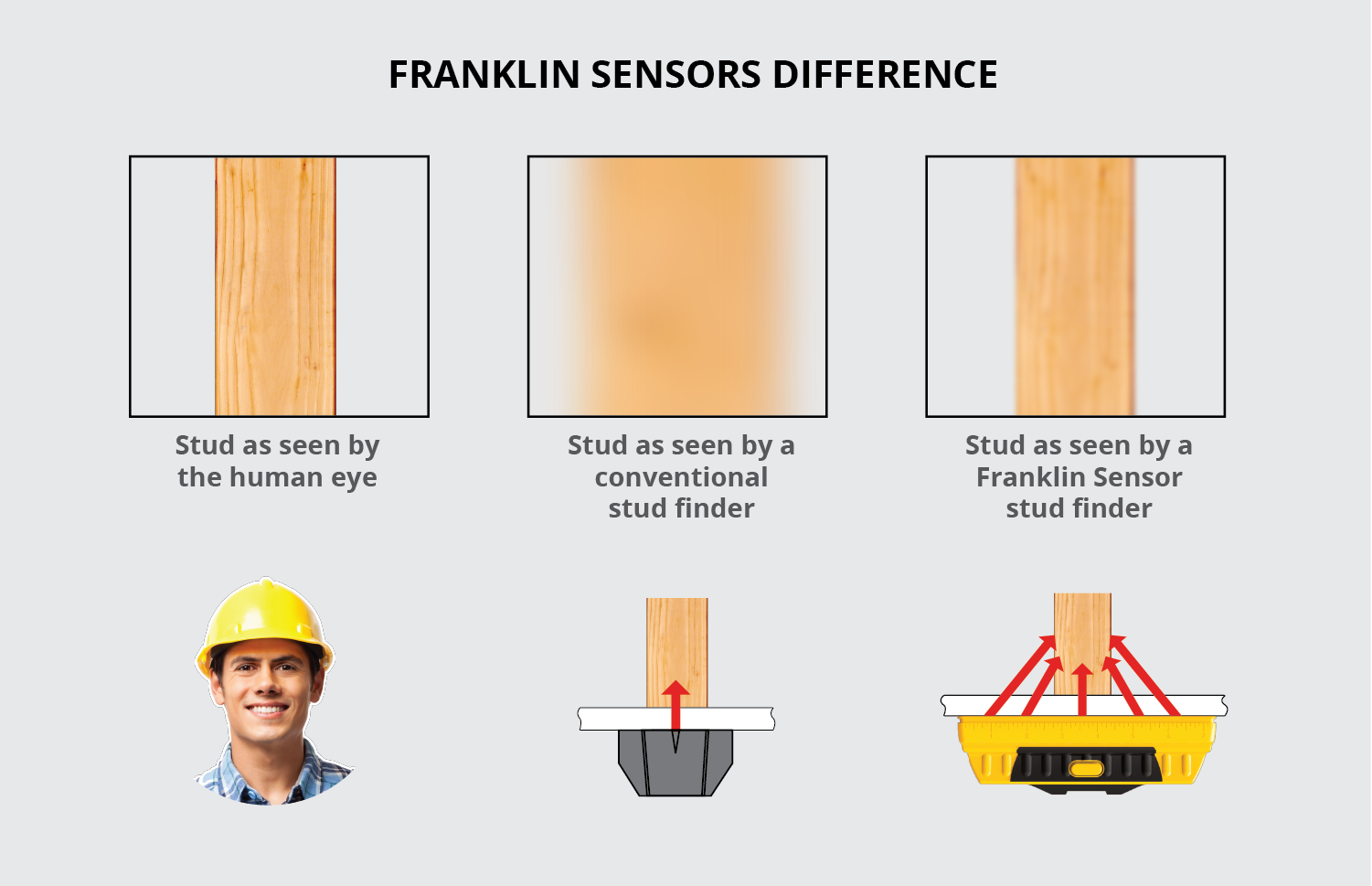
THE REAL PROBLEM: NOT ENOUGH SENSORS
Conventional stud finders rely on a small number of sensors, typically just one or two, to detect changes in density behind the wall. Franklin Sensors changed this up with patented technology, including 3-13 sensors and a wide, horizontal design.
WHY MORE SENSORS = MORE ACCURACY
More sensors mean more reference points across the wall. Instead of guessing at what might be behind the surface, Franklin Sensors stud finders measure with context, analyzing a broader data set to pinpoint studs with remarkable accuracy.
Here’s what that means in practice:
- No calibration needed. You can start scanning anywhere, even over a stud.
- Faster, easier results. You get an instant reading the moment you place the tool on the wall.
- Accurate stud detection even in tricky situations. Double studs? Odd framing? No problem.
- Works on more surfaces. Franklin Sensors devices handle unconventional walls better than traditional stud finders. When using our 13-sensor M210, 710, or 710+ models:
- 83% of users report success on heavily textured walls
- 80% of users report success on lath and plaster
- 68% of users report success on OSB or plywood
SO, DO STUD FINDERS WORK?
The short answer is: yes, when they’re designed to.
WHAT ABOUT MORE EXPENSIVE CONVENTIONAL STUD FINDERS? WILL THEY BE MORE ACCURATE?
When it comes to conventional stud finders, you might think you get what you pay for, but that’s actually not the case. Traditional stud finders always have 1-2 sensors, even at the higher end. So, with more money, you’re not paying for more accuracy: you’re paying for more bells and whistles.
With Franklin Sensors, it’s different. Our premium models come equipped with more sensors, which directly translates into greater accuracy and reliability. Take the ProSensor M210—it has 13 sensors for maximum accuracy, compared to the 7 sensors in the more affordable ProSensor M70.
So, when you invest in a Franklin Sensors stud finder, you’re not just paying for features. You’re buying better performance where it counts most.
WHAT ABOUT MAGNETIC STUD FINDERS?
Magnetic stud finders are often praised for being “accurate”, but what they’re actually detecting is the drywall screw, not the stud itself.
While it’s true that screws are usually fastened into studs, they’re almost never perfectly centered. In fact, drywall screws are typically located near the edge of a stud, and sometimes, especially in rushed construction, they can miss the stud entirely.
So while a magnetic stud finder might help you locate a screw, it won’t give you reliable information about where the center of the stud is, or if you’re even hitting a stud at all. That can lead to misaligned holes, weak mounting points, and frustrating trial and error.
For truly accurate stud detection, especially when precision matters, electronic, multi-sensor stud finders are the better choice.
Ready to find studs?
Explore stud finders that actually work now.